
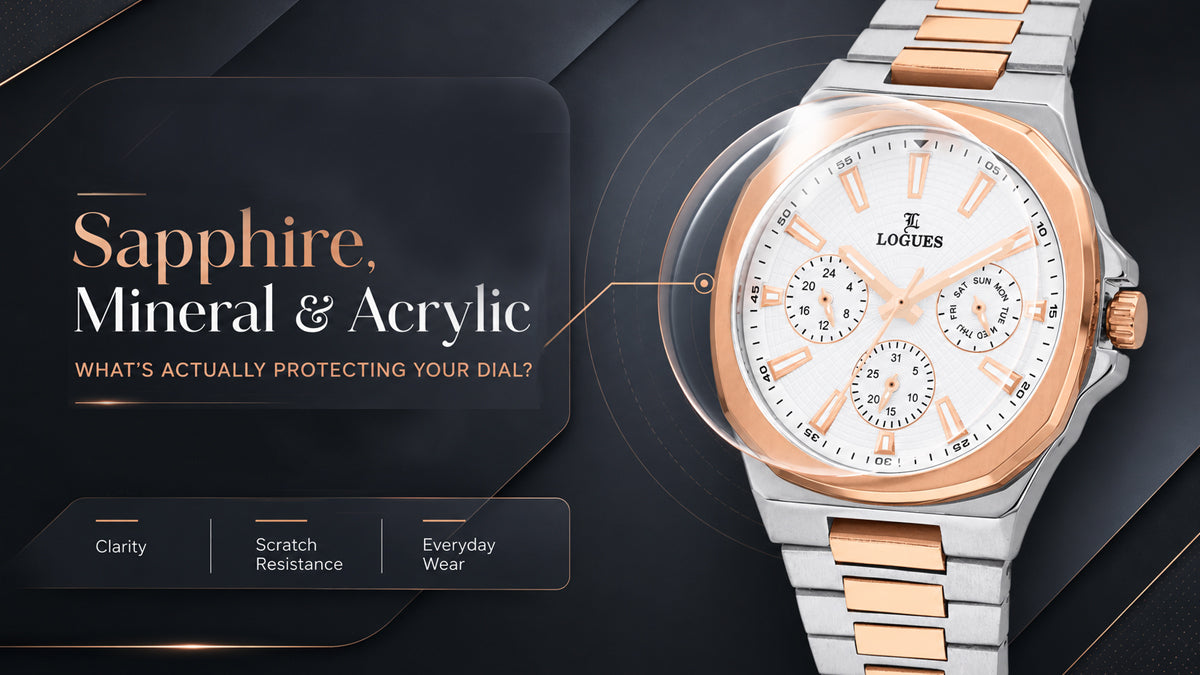
The crystal is the part of a watch you look at constantly and think about almost never. It is also the part that absorbs nearly every accidental impact the watch receives, for a simple geometric reason. It sits on the outer face of your wrist, proud of the case, leading the way through doorframes, desk edges, car doors and gym equipment. Knowing what material is fitted to your watch tells you how much care it needs, how it will look in two years, and whether the scratch you just noticed can be removed or is permanent.
The Three Materials You Will Encounter
Acrylic is a hardened transparent plastic, and it was the standard crystal material for decades. It is light, inexpensive to produce, easily domed into the shapes vintage watches used, and almost impossible to shatter, which is exactly why military watches used it. Its weakness is obvious the moment you own one, because it scratches from very nearly anything. Its compensating strength is that those scratches polish out completely at home in a few minutes with a mild abrasive paste. Modern watches rarely use acrylic except in deliberately retro designs where the warm distortion of a domed plastic crystal is the point.
Mineral glass is silica glass that has been heat treated or chemically strengthened to increase its surface hardness and impact resistance. It resists everyday scuffing far better than acrylic and it is the default across most of the watch market. On the Mohs hardness scale it sits at roughly 5. Ordinary sand, which is largely quartz, sits at around 7. That single comparison explains why so many watches come back from a beach holiday with a hazed crystal and why mineral glass, while perfectly serviceable, will accumulate fine marks over years of wear.
Sapphire crystal is synthetic corundum, grown in a laboratory from aluminium oxide and then sliced and polished. At 9 on the Mohs scale it is second only to diamond, which means that essentially nothing encountered in ordinary daily life will scratch it. Growing the boules is slow and energy intensive, and machining a material that hard consumes cutting tools rapidly, which is why sapphire commands a significant premium. Its one genuine weakness is brittleness. Because it is so hard it has very little give, so a sharp impact on a corner is more likely to chip or crack it than to leave a scuff.
Where Sapphire Coated Glass Fits
Sapphire coated glass is mineral glass with a hard sapphire layer applied to the outer surface. It is a deliberate engineering compromise rather than a marketing shortcut, and it is worth understanding on its own terms. The scratching that actually degrades how a watch looks over time is surface abrasion on the outer face, caused by the crystal rubbing against doorframes, desk edges, keyboards and clothing. A sapphire layer sits exactly where that abrasion happens and resists it, while the mineral glass beneath retains the impact tolerance and the cost profile that make it practical.
What it is not, and should never be described as, is solid sapphire. The distinction matters because the two materials behave differently under a heavy impact and because a buyer deserves to know which one they are getting. What sapphire coated glass does very well is prevent the fine hairline scratching that accumulates over two or three years of ordinary wear and makes an otherwise sound watch look older and more tired than it is. That is the specification chosen across every Logues reference, and that is the reasoning behind it.
How to Identify What You Already Have
There are several folk tests circulating and it is worth being honest about how well they work. The water drop test involves placing a droplet on the crystal and observing whether it holds a tight bead rather than spreading flat, on the basis that surface tension behaves differently on sapphire. It is indicative at best and easily confounded by any residue on the surface. Tapping the crystal lightly with a fingernail produces a higher, harder sound on sapphire and a dull sound on acrylic, which is more reliable but requires something to compare it against. Temperature is the most useful of the three, because sapphire conducts heat away from your fingertip faster and therefore feels colder and stays cold longer than mineral glass.
None of these is conclusive. The product specification is, which is why any brand worth buying from states the crystal material plainly rather than leaving you to guess.
Caring for the Crystal You Have
The most effective crystal care has nothing to do with cleaning products and everything to do with anticipation. Something close to ninety percent of crystal damage occurs in a moment the owner could have predicted a minute in advance. Moving furniture, carrying boxes, lifting weights at the gym, working under a car, doing anything where your wrist will pass close to concrete, metal or a doorframe. Taking the watch off for those twenty minutes prevents almost everything.
For cleaning, a microfibre cloth and plain water is the entire requirement. Household glass cleaners should be avoided because most contain ammonia, which attacks case gaskets over repeated exposure and quietly reduces water resistance while making the crystal look excellent. If your crystal carries an anti reflective coating, treat it more gently still, because that coating is a soft applied layer that can be worn away by abrasive cleaning long before the crystal underneath shows any wear at all. Store the watch face up in a drawer or a box rather than face down on a hard surface, which is a habit that costs nothing and prevents a specific and avoidable kind of damage.
What to Do About a Chip or Crack
Stop wearing the watch immediately. A chipped crystal is not simply a cosmetic problem, because glass or sapphire fragments inside a sealed case can migrate into the movement, and a compromised crystal seal admits dust and moisture continuously from that point onward. Both problems compound quietly while the watch continues to run and appear fine.
Crystal replacement is a routine, quick and comparatively inexpensive service operation. A movement rebuild after three months of grit circulating through the gear train is neither. The economics of acting immediately are not close.
Final Thoughts
The crystal is the cheapest part of a watch to protect through habit and one of the more visible parts to neglect. Understanding what is fitted to yours tells you how much latitude you have, and taking the watch off during the twenty minutes a day when it is genuinely at risk does more for its long term appearance than any product you can buy.
Every Logues watch uses sapphire coated glass over a stainless steel case, chosen specifically to resist the everyday surface abrasion that makes watches look old before they are. Explore the automatic and analogue collections to see the crystal and bezel treatment on each reference.

Leave a comment