
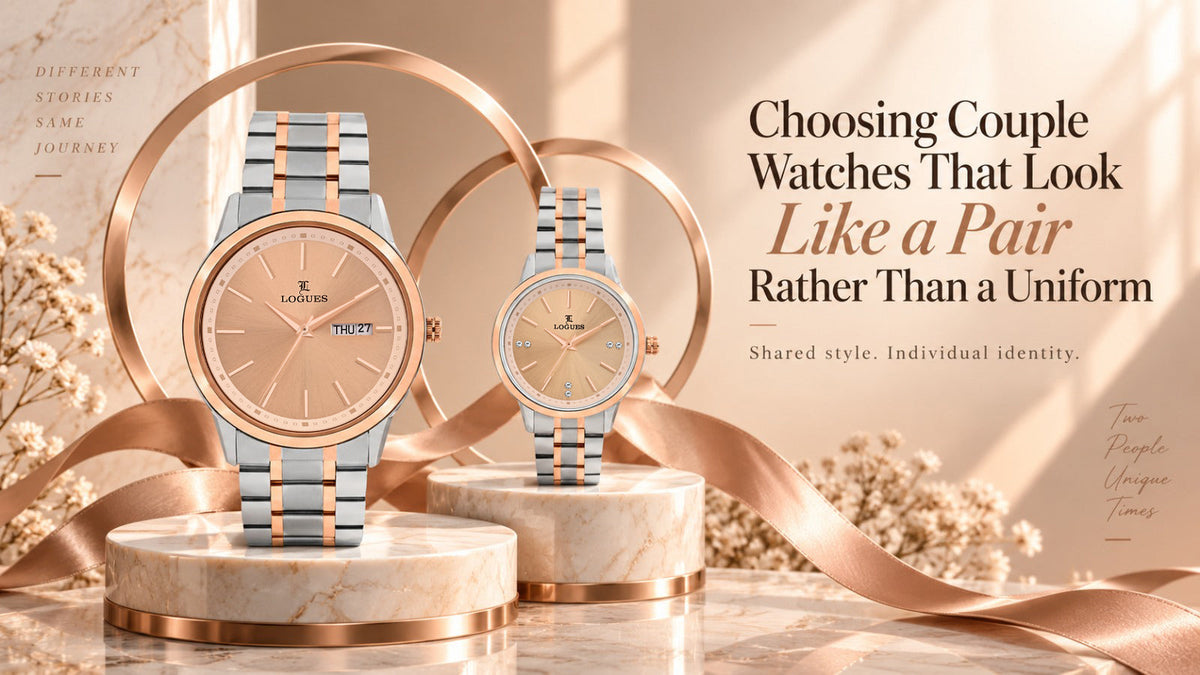
Choosing Couple Watches That Look Like a Pair Rather Than a Uniform
Most couple watch sets fail for the same structural reason, and it has nothing to do with the quality of the watches. They are the same design manufactured in two sizes, which reads on two wrists as a uniform rather than as a pair. The effect is unmistakable and slightly awkward, and it is the reason so many sets are worn enthusiastically for a month and then separated permanently, with one watch entering regular rotation and the other going into a drawer. The sets that survive work differently. They share a design language without duplicating a design, so that each watch stands on its own wrist while still visibly belonging to the other.
Match the Finish Before Anything Else
The single strongest visual link between two watches is the metal tone of the case, and it does more work than every other shared element combined. Two watches in the same steel finish, or the same rose gold tone, will read as a deliberate set from across a room even if their dials, sizes and complications are entirely different. The eye registers metal tone first and at distance, long before it can resolve any detail on a dial.
The corollary is unforgiving. Get the finish wrong and no amount of matching elsewhere will rescue the pairing, because a steel case sitting next to a rose gold one simply looks like two unrelated watches that happen to be in the same room. There is no styling around it. Settle the finish first, and everything downstream becomes a matter of preference rather than a matter of getting away with something.
Let the Case Sizes Differ Genuinely
A pair should show clear and intentional size separation, because ambiguous separation reads as a manufacturing inconsistency rather than a design decision. Roughly 38 to 42 mm for the larger watch alongside 30 to 34 mm for the smaller one produces a proportion that reads correctly and looks considered. Sets that differ by only two or three millimetres achieve the worst of both outcomes, being neither convincingly matched nor convincingly distinct.
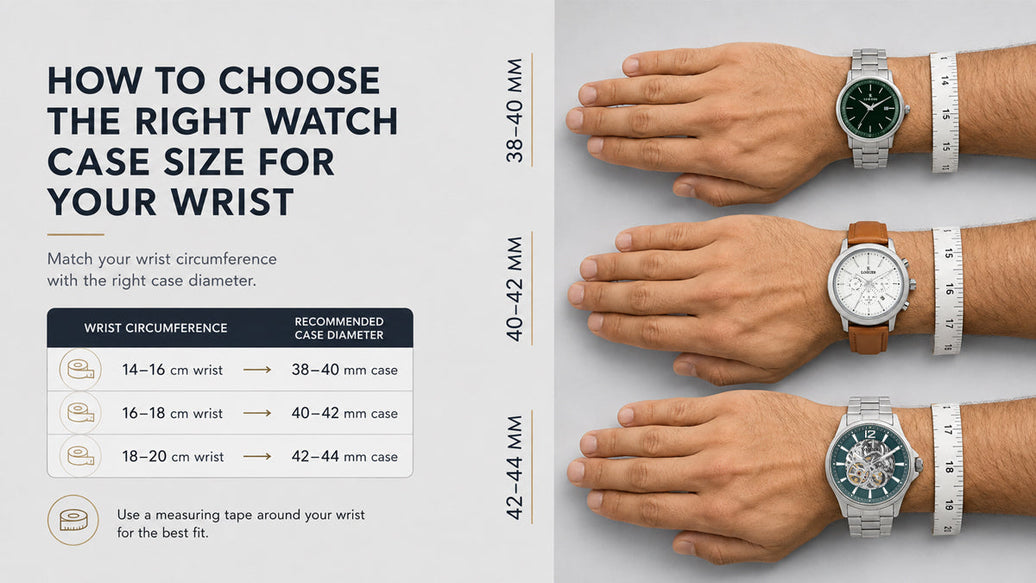
The important caveat is that the smaller watch must be sized to the wrist that will actually wear it rather than to the ratio. A 34 mm case on a 145 mm wrist is a substantial watch, and the pairing ratio is not a reason to overwhelm someone's wrist. Measure first, then choose within the range that fits.
Repeat Exactly One Detail
This is the principle that separates a genuinely well chosen pair from a matching set, and it is worth applying strictly. Choose one design element to carry across both watches, and allow everything else to differ freely. The shared element might be the same dial colour rendered in two different layouts, the same hour marker style such as applied batons on both, the same strap material in two widths, or the same case shape in two sizes.
One repeated element reads as intentional and elegant. Two starts to look coordinated. Three or more collapses back into the uniform problem the whole exercise was meant to avoid. The restraint is the design.
Allow the Dials to Be Different
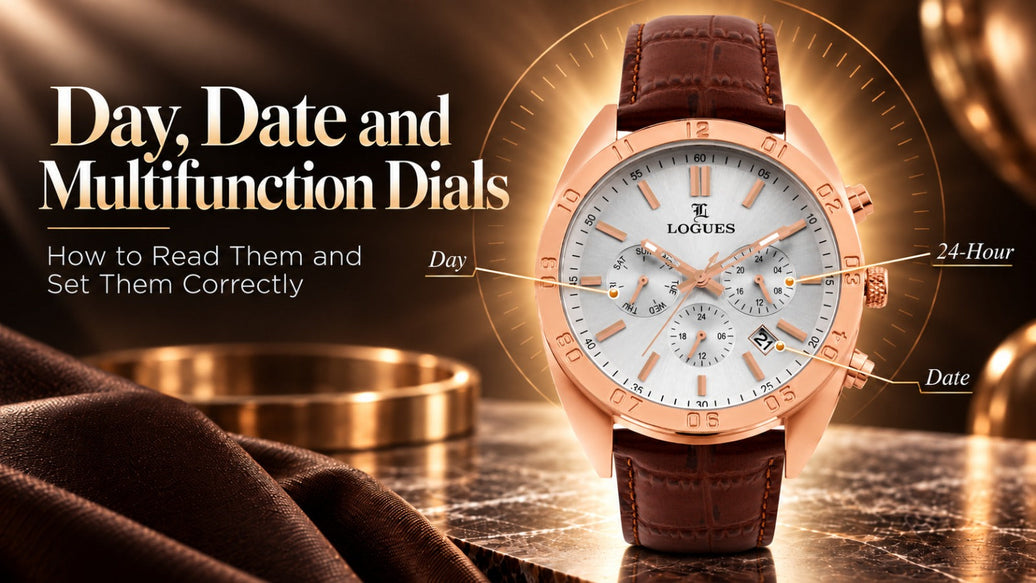
The dial is where each watch becomes an individual object rather than half of a set, and it is the element most worth differentiating. A textured or guilloche dial on one paired with a plain sunburst on the other, kept within the same colour family, works consistently well. So does a multifunction layout on the larger watch beside a clean two hand dial on the smaller one, where the difference in information density mirrors the difference in scale.
Difference is the intention here rather than a compromise. The coordination is being handled by the case finish and the single repeated detail, which frees the dials to be genuinely distinct.
Account for Two Different Wardrobes
A couple watch set lives on two different wrists, in two different wardrobes, in two different working environments, and it will only be worn regularly if it works in all of them. If one of you wears formal shirts every day and the other does not, then a slim leather strap on one watch and a steel bracelet on the other is not a failure of matching. It is the correct answer, and the shared case finish will hold the pairing together perfectly well.
The test worth applying is whether each watch would be worn happily on a day when the other person is not present. A pair that only makes sense when worn together is a pair that gets worn perhaps twice a year, and the money would have been better spent on two separate watches.
Practical Checks Before Buying
Confirm both watches carry the same warranty period and the same movement type, so that servicing stays on a common schedule rather than diverging. Check both case thicknesses rather than only the diameters, since it is common and generally desirable for the smaller watch in a set to be noticeably slimmer. Check the strap or bracelet sizing on the smaller watch specifically, because many sets ship with a strap sized for an average wrist and limited adjustment range, which is a frustrating discovery after a gift has been opened. And consider how the materials will age relative to each other, since two leather straps will develop patina together while one leather and one steel will diverge visibly over a year, which is entirely fine if it was intended and jarring if it was not.
Notes on Gifting
Couple watches are bought most often for anniversaries, weddings and Karva Chauth, and frequently as a surprise, which removes the option of asking. When you are choosing blind, the safest specifications are a steel case finish, a case diameter in the middle of the appropriate range, and a neutral dial in white, silver or navy. That combination survives almost any taste and almost any wardrobe, and it leaves room for the recipient to change the strap later if they want to make it more their own.
Final Thoughts
A good pair is built on one shared foundation and one shared detail, with genuine difference everywhere else. That structure produces two watches that look related without looking issued, and more importantly it produces two watches that both get worn.
The Logues couple watch collection is built around matched pairs rather than duplicated designs, with each set sharing a case finish and one repeated dial element while carrying two distinct dial layouts and clearly separated case sizes. Browse the collection to see how each pair is constructed.


Leave a comment