
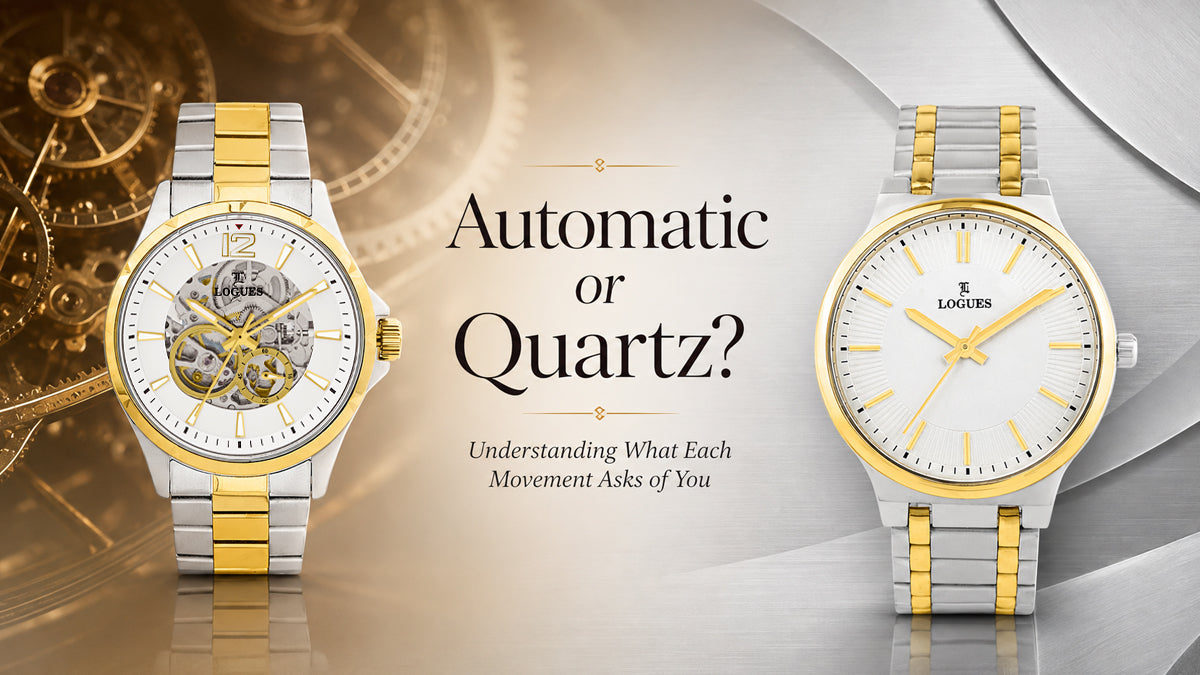
Every wristwatch ever made runs on one of two fundamentally different ideas about how to divide a day into equal parts. One relies on a mainspring slowly releasing stored energy through a train of gears and a beating balance wheel. The other relies on a battery pushing current through a quartz crystal that vibrates at a frequency so stable it can be counted. Both arrive at the same answer, but they arrive by completely different routes, and the route determines almost everything about what it is like to own the watch. Most buyers glance at the movement line on a specification sheet, register that it exists, and move on. That is a genuine missed opportunity, because the movement is the single decision that will shape how the watch behaves on your wrist every day for the next five years.
How a Quartz Movement Keeps Time
A quartz movement works on the piezoelectric properties of quartz crystal. When an electrical current from the battery is applied to a small tuning fork shaped piece of quartz, the crystal oscillates at a precise and extremely consistent frequency, typically 32,768 times per second. An integrated circuit counts those oscillations and divides them down into one clean electrical pulse per second, which drives a stepper motor that advances the seconds hand. Because the reference frequency is a physical property of the crystal rather than a mechanical construction, it is remarkably resistant to the things that disturb a mechanical watch. Gravity, wrist position and how recently the watch was worn have no measurable effect.
The practical consequence is accuracy measured in seconds per month rather than seconds per day. Nothing you do changes that figure meaningfully. You can leave a quartz watch in a drawer for six weeks, pick it up before a wedding, and the time will still be correct without you touching anything. That reliability is the reason quartz dominates the watch market by volume and the reason it remains the sensible choice for anyone who owns one watch and needs it to simply work.
Quartz also unlocks design possibilities that mechanical movements cannot easily reach. Without a mainspring barrel, a balance wheel assembly and an oscillating winding rotor to accommodate, the movement itself is thin. That thinness travels through to the case. If you want a genuinely slim dress watch that slides under a shirt cuff without catching, quartz makes that far easier to engineer and far cheaper to achieve. The trade is a service item on a schedule. Every two to three years the cell needs replacing, and a dead cell left inside a case for a long period carries a real risk of leaking and damaging the circuit beneath it. A flat battery deserves attention rather than indifference.
How an Automatic Movement Keeps Time
An automatic watch contains no battery and no electronics. A weighted semicircular rotor sits over the movement and pivots freely with the natural motion of your arm as you go about your day. That motion is transmitted through a reduction gear train into the mainspring barrel, where it winds a coiled flat spring. The spring then releases that stored energy at a controlled rate through the going train and out to the escapement, where a balance wheel oscillating back and forth several times per second regulates exactly how quickly the energy is allowed to escape. It is a chain of purely mechanical consequences, and every part of it is visible in principle and often visible in practice through an exhibition case back.
Logues automatic calibres carry roughly a 36 hour power reserve, meaning a fully wound watch will continue running for about a day and a half after you take it off. That single number describes the entire ownership experience. Worn daily, the watch never stops, because your arm keeps topping up the spring faster than the escapement drains it. Left on a nightstand over a long weekend, it will be sitting dead on Monday morning, and you will pick it up, wind it, reset the time and the date, and put it on. Some people find that a small daily irritation. Others find it the entire reason they wanted a mechanical watch in the first place.
Accuracy behaves differently too. A mechanical calibre is judged in seconds per day, and its rate genuinely shifts with temperature, with the position the watch rests in overnight, and with how tightly the mainspring happens to be wound at that moment. A well regulated automatic that runs a handful of seconds fast each day is behaving exactly as designed, not failing. Understanding that in advance prevents a great deal of unnecessary worry, because a buyer who expects quartz precision from a mechanical watch will always conclude something is wrong.
What an Automatic Gives You That Quartz Cannot
There is a reason mechanical watchmaking survived the arrival of a cheaper and more accurate technology, and it is not nostalgia alone. An automatic gives you a seconds hand that sweeps in many small increments per second rather than ticking once, which reads as continuous motion across the dial and is the most immediately visible difference between the two. It usually gives you an exhibition case back, through which you can watch the rotor swing and the balance wheel beat, which turns the watch from an object that displays information into a small machine you happen to be wearing. And it gives you something that will still be repairable in thirty years, because a mechanical movement is made entirely of parts that a watchmaker can clean, replace and regulate, with no circuit that will eventually become unobtainable.
Choosing Between Them
There are only three questions that actually matter, and they are all about you rather than about the watches. The first is how often you will genuinely wear it, because a watch worn every day suits an automatic perfectly while a watch worn twice a month suits quartz, since you want it running when you reach for it rather than dead. The second is how many watches you intend to own, because a single watch collection leans heavily toward quartz convenience while a rotation of three or four leans toward automatic, given that you are already handling and setting each piece as it comes back into use. The third is what you actually want from the object, because if a watch is a tool for reading the time then quartz does that job with less thought demanded from you, and if a watch is something you enjoy owning as an object then an automatic gives you a great deal more to be interested in.
In Perspective
The two movements are not ranked against each other, and any comparison that treats one as the lesser version of the other has misunderstood what each was built to do. Quartz is an engineering answer to the question of how to make timekeeping accurate, thin and effortless, and it answers that question extremely well. Automatic is an engineering answer to the question of how to store and release energy mechanically with precision, and it answers that question with several hundred parts working in sequence. A quartz watch asks almost nothing of you. An automatic asks for regular wear or a few turns of the crown, and returns something in exchange.
Final Thoughts
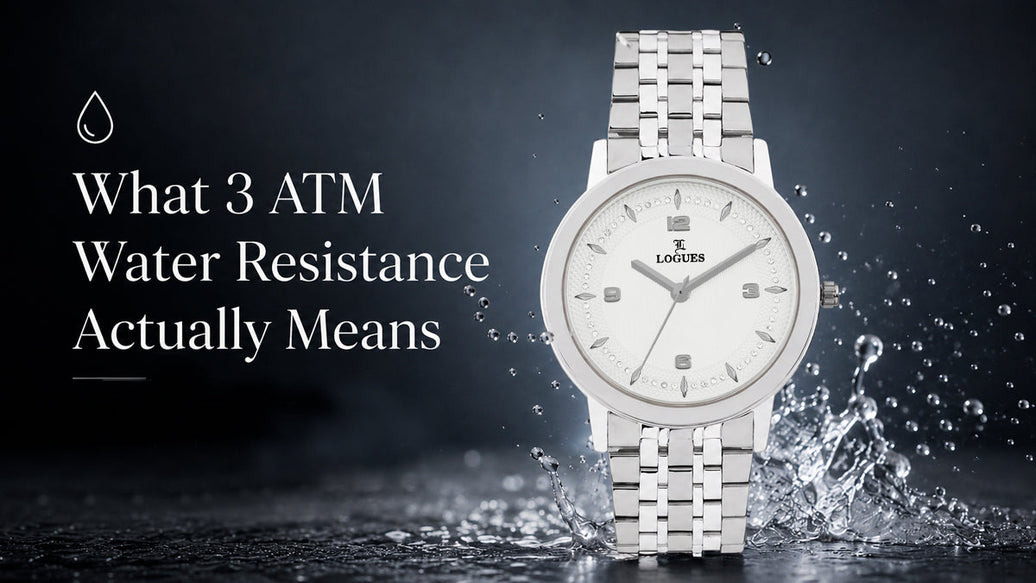
The build quality of a watch is decided long before the movement is chosen, in the case material, the crystal, the finishing and the bracelet construction. Across the Logues range those elements are held constant. Every reference uses a stainless steel case, sapphire coated glass and 3ATM water resistance, whether the movement inside is a Japanese quartz calibre or a self winding automatic with a roughly 36 hour power reserve and an exhibition case back.
What changes between them is not how well the watch is made. It is what the watch asks of you, and what it gives you back.
Explore the Logues Automatic collection to see the mechanism through the case back, or browse the full analogue range for the slimmer quartz references. Every product page lists the movement type, case dimensions and crystal so you can make the comparison for yourself before you buy.





Leave a comment