
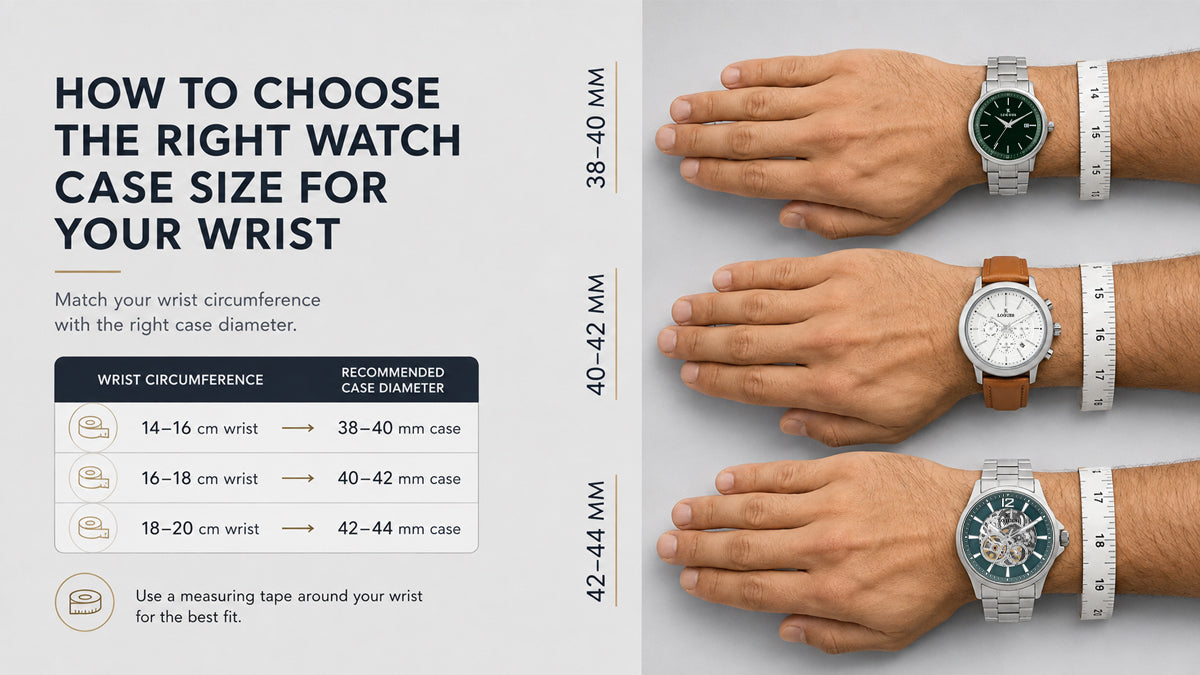
A watch that does not fit reads as wrong from across a room, even to people who have never thought about watches for a moment in their lives. They will not be able to tell you why. They will simply register that something is slightly off, in the same way a jacket with sleeves an inch too long registers. Fit is the quiet difference between a watch that looks bought and a watch that looks chosen, and unlike almost every other aspect of watch buying it can be settled definitively in about two minutes with a strip of paper. It is the single most useful thing you can do before spending money online, where you cannot try anything on.
Start by Measuring Your Wrist Properly
Take a tailor's tape, or failing that a strip of paper and a ruler, and wrap it around your wrist just above the wrist bone, at the point where the watch will actually sit rather than higher up the forearm. Keep it snug without compressing the skin. Mark where the tape meets itself, lay it flat, and read the measurement in millimetres. Most adult Indian wrists fall somewhere between 150 and 190 mm, and that single number carries most of the decision on its own.
Matching Case Diameter to Wrist Circumference
Case diameter is measured straight across the case at its widest point, excluding the crown, and it is the specification most listings lead with. As a working starting range, a wrist under 155 mm suits a case between 34 and 38 mm. A wrist between 155 and 170 mm suits 36 to 40 mm. A wrist between 170 and 185 mm suits 39 to 43 mm. A wrist above 185 mm can comfortably carry 42 to 46 mm.
Underneath those ranges sits an older and more reliable rule that has not been improved upon. The case should not overhang the flat upper surface of your wrist. If the lugs, meaning the four arms that hold the strap to the case, extend past the edges of your wrist and force the strap to bend sharply downward at an angle, the watch is too large regardless of what the diameter number suggests. This single test catches the most common sizing error in online watch buying, and it costs nothing to apply.
Thickness Does the Damage That Diameter Gets Blamed For
Diameter receives all the attention and thickness quietly causes most of the discomfort. A 40 mm case that measures 14 mm thick sits high off the wrist, catches on shirt cuffs, rocks slightly when your wrist is against a desk and feels considerably heavier than its actual weight. The same 40 mm diameter at 9 mm thick slides under a cuff without noticing and disappears from your awareness within an hour of putting it on.
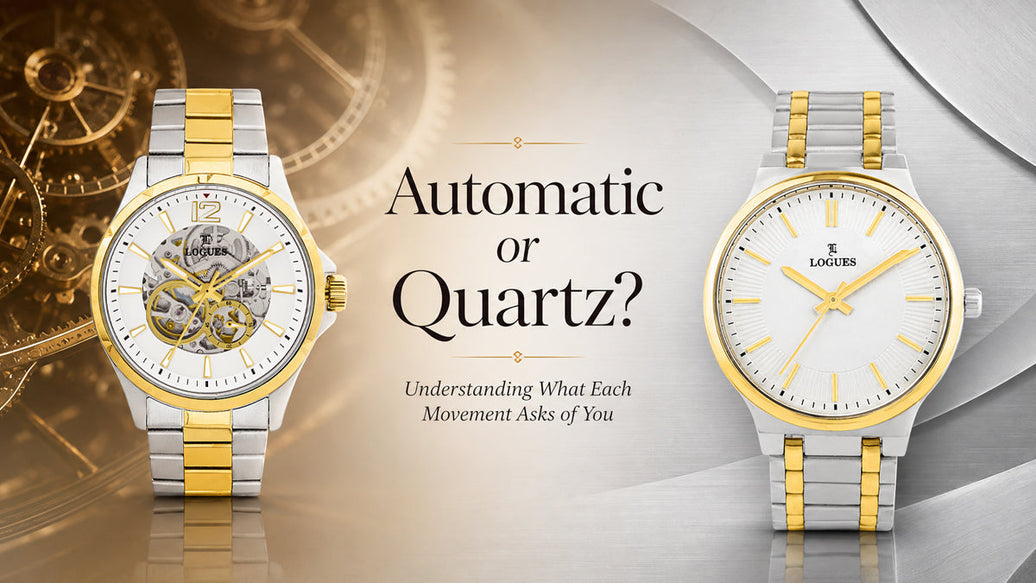
There is a mechanical reason thickness varies. Automatic movements need vertical space for a mainspring barrel and an oscillating rotor stacked above the gear train, so mechanical watches are almost always thicker than quartz watches of the same diameter. That is not a flaw in either one, but it means that if you wear formal shirts every working day, thickness deserves more of your attention than it usually gets, and possibly more than diameter.
Lug to Lug Is the Number Almost Nobody Checks
Lug to lug is the distance measured from the tip of the upper lugs to the tip of the lower lugs, and it describes how much vertical space the watch occupies on your wrist. It is the truest single measure of whether a case will fit, and it is frequently absent from product listings, which is precisely why the buyers who know to look for it end up with better fitting watches.
As a rough guide, keep the lug to lug measurement at or below approximately eighty percent of the width across the flat top of your wrist. In practical terms a 44 mm lug to lug sits comfortably on the majority of wrists. Beyond 50 mm you need a genuinely large wrist for the watch to sit flat rather than perching. Two watches with identical 40 mm diameters can differ by 6 mm in lug to lug depending on lug design, which is why one fits and the other does not.
How Dial Design Changes Apparent Size
Two cases of identical diameter can look a full size apart on the wrist, and understanding why gives you useful room to manoeuvre when you are caught between two sizes. Light coloured dials, thin or absent bezels, high contrast markers and steel bracelets all make a watch read larger. Dark dials, wide or stepped bezels, subdial layouts and tapered leather straps all make the same case read smaller and more contained.
The practical application is straightforward. If you are between sizes, choose the smaller case with a lighter dial rather than the larger case with a dark one. You get the visual presence you wanted without the fit problems that come with genuinely oversized cases.
Matching Size to Purpose
A watch worn to an office every day can afford to be conservative, which usually means 38 to 40 mm, relatively slim, on leather or a mesh bracelet, with an uncluttered dial that reads instantly. A watch worn at weekends has far more latitude for a larger case, a bolder dial and a heavier bracelet, because nothing needs to fit under a cuff and nothing needs to stay quiet in a meeting. If you are building toward more than one watch, letting size follow purpose is a more useful organising principle than picking a size you like and repeating it.
The Two Minute Sanity Test
Put the watch on and look straight down at it from directly above. You should be able to see wrist on both sides of the case, with the lugs comfortably inside the edges. Then bend your wrist fully forward as though checking the time while carrying something. The case back should remain flat against your skin without the lugs digging into the sides of your wrist or the watch levering away from it. If the watch passes both tests, the size is right, and no amount of specification comparison will improve on that answer.
Final Thoughts
Case size is the one variable in watch buying where the correct answer is genuinely personal and genuinely measurable. Nobody else's wrist has any bearing on it, and no trend toward larger or smaller cases changes the geometry of yours. Measure once, note the number, and use it every time you shop.
The Logues range spans 36 to 44 mm across the analogue, multifunction and automatic lines, with case diameter, thickness and lug width listed on every product page so you can check the numbers against your own measurement before ordering.


Leave a comment